The University of British Columbia
UBC - A Place of Mind
The University of British Columbia Vancouver campus
Communications Law at Allard Hall
  • Home
  • Issues/Your Take
  • 2023 Current Syllabus
    • 2022 Syllabus
    • 2021 Syllabus
    • 2020 Syllabus
    • 2019 Syllabus
    • 2018 Syllabus
    • 2017 Syllabus
  • Slides & Materials
  • Group Presentations
  • Socrates
  • Statutes & Regulations
  • About
    • Thanks
    • Jon’s Bio
  • The Cloud

    The “cloud” has come to mean the storing and accessing of data (including programs) over the internet rather than on on our device (computer, phone or otherwise). The official definition of the U.S. National Institute of Standards and Technology is: “Cloud computing is a model for enabling convenient, on-demand network access to a shared pool of […] Read More

Runnymede Society Debate: Is Net Neutrality a Threat to Innovation?

Am honoured to have been asked to moderate this debate on Net Neutrality tomorrow in Room 104 of the Allard School of Law. The speakers will be Tom Struble, Counsel at R Street in Institute in Washington, DC, and Ian Bell, internet entrepreneur.

Hope to see you there.

Jon

Read More | No Comments

Role of Search Engines in a Democratic Discourse

Last course, we touched on what should be the role of search engines (private entities) in showing links on the results pages. Not only the search engines designed algorithms to provide the more relevant information based on their own “editing choice”, but they tend to personalize the results based on the user’s profile. I wonder how a democratic discourse could be guaranteed on the Internet. I have only done preliminary researches and my thoughts about it are not clearly structured. However, I decided to share it with you; and you might want to contribute.

The United States has given the protection of freedom of expression to results pages. For what I understand, the American courts considered that private entities express their opinions through the search engines. The search results are opinions. Those opinions are protected speech under the First Amendment – freedom of expression rights. E.g.: Search King Inc. v. Google Technology, Kinderstart.com LLC et al. v. Google Inc., Jian Zhang et al. v. Baidu.com Inc.

One of my concerns is that the listener/reader right are not considered.

The Canadian freedom of expression right, pursuant, Edmonton Journal v. Alberta (Attorney General), [1989] and R. v. National Post, [2010], seems to include the right to receive and access information if it is justified by the public interest.

In January 2016, the Office of the Privacy Commissioner (OPC) of Canada launched a public consultation on the online reputation. OPC received 28 written propositions. Two years later, January 26, 2018, OPC released it draft “Position Paper on Online Reputation” (the “Proposition”) (https://www.priv.gc.ca/en/about-the-opc/what-we-do/consultations/consultation-on-online-reputation/pos_or_201801/#fn15-rf). The Proposition relies on the opinion that search engines are subjected to PIPEDA and that PIPEDA provides a “de-indexing right”.  The search engines would have to evaluate the merits of a Canadian request to de-index a result on: a case-by-case basis, the materiality impact on the individual’s interests, and balance the public interest in the information. And then, if concluded in favour of de-indexation, remove the link (not the content) to a search result when a name is searched from Canada by using geo-identifying technologies. It is an important power that is given to private entities; which is determining public interest and balancing fundamental rights for Canadian without or little government oversight. (A recurrent theme in our course’s discussions: powers given to private entities vs our government).

The following avenues of reflection, in my view, would merit further examination:

  • Search engines have its own opinion protected by the right of freedom of expression: The Proposition does not seem to consider the inherent protection of freedom of expression in the liberal “editing choice” of the search engines. Maybe it is part of the balance evaluation; or maybe it does not exist in the Canadian legal landscape. I don’t know if there are any Canadian cases on that subject.
  • Territoriality difficulties: After the Canadian order to de-index a website on a global basis in Google Inc. v. Equustek Solutions Inc., Google sought a declaratory injunction to make unenforceable the Canadian order. Google succeeded based on the immunity for interactive service providers given under the United States Communications Decency Act (Section 230 of the Communications Decency Act “No provider or user of an interactive computer service shall be treated as the publisher or speaker of any information provided by another information content provider”) (https://www.lexology.com/library/detail.aspx?g=11d2eb07-98c1-4dad-bdc5-a003e5fb58f0). How could we assure Canadian orientation on online liability of search engines to be enforceable?
  • Where do we find a ground to protect online democratic discourse which could be inhibited or promoted by search engine opinion?

Note about the Proposition: The Proposition relies on the opinion that search engines are subjected to PIPEDA because the search engines “collects, uses or discloses [personal information] in the course of commercial activities” (paragraph 4(1)(a)). The “commercial activities”, in the OPC opinion, in those circumstances are rooted in their ability to sell advertising space; and the use takes the form of putting personal information when a search request is made under an individual’s name – creating a “profile of the most relevant information”. In the OPC’s opinion, PIPEDA provides a “de-indexing right”:

  • Principles 4.6, 4.9 of Schedule 1: Accuracy, completeness and currency of the personal information for the purposes for which it is to be used can be challenged. Therefore, the results must be amended if the results are not accurate, complete or up-to-date.
  • Subsection 5(3) of PIPEDA: Appropriate purposes of the personal information collect, use or disclose. The “appropriate” purpose is evaluated under the criterion of a reasonable person under the circumstances. Therefore, in the OPC opinion, a reasonable person will not find appropriate the use of personal information if the content is unlawful or unlawfully published or the accessibility of the information causes harm that is not outweighed by public interest.

Note: On June 2017,  the Europeen “Commission fines Google 2.42 billion euro for abusing dominance as search engine by gibing illegal advantage to own comparison shopping service” http://europa.eu/rapid/press-release_IP-17-1784_en.htm

Read More | No Comments

Class 8 Slides

Here they are. A post facto remix of slides for my improvised talk today. Laura & Claudio’s as delivered.

Back to Part 3 of broadcasting policy next week. Am also extending “Question of the Week” to two so that we can get a bit deeper into Canadian Content before you answer.

Jon

Read More | No Comments

Question of the Week (Classes 8 + 9): Should the rules regarding Canadian Content contained in the Broadcasting Act & Regulations continue?

Canadian Content regulation has for decades been a prime focus in any debate about our communications system. In the digital media age, the issue is still present but sometimes feels like it is covered up by the overwhelming changes and innovations bred through the mostly unregulated and seemingly more urgent issues of social media today. So though we may feel it’s still important to define and understand the long term strategies, advantages and cost of supporting Canadian creative endeavours, WHAT ABOUT FAKE NEWS? WHAT ABOUT PRIVACY? AND BIG DATA? AND A.I.? AND MONOPOLY? AND NET NEUTRALITY? AND…? AND…? AND COULD THE CANUCKS REALLY NOT GET ANY DRAFT PICKS FOR THOMAS VANEK?

You get the idea. Canadian Content, both conceptually and practically seems to be off the front pages of our minds. Are we (the public) negligent in seemingly letting it slide from urgent view? Is it as important as it was? Is it important?

SOME SOURCES:

Broadcasting Act

3(1) It is hereby declared as the broadcasting policy for Canada that

 (f) each broadcasting undertaking shall make maximum use, and in no case less than predominant use, of Canadian creative and other resources in the creation and presentation of programming, unless the nature of the service provided by the undertaking, such as specialized content or format or the use of languages other than French and English, renders that use impracticable, in which case the undertaking shall make the greatest practicable use of those resources;

(l) the Canadian Broadcasting Corporation, as the national public broadcaster, should provide radio and television services incorporating a wide range of programming that informs, enlightens and entertains;

(m) the programming provided by the Corporation should(i) be predominantly and distinctively Canadian,

(t) distribution undertakings(i) should give priority to the carriage of Canadian programming services and, in particular, to the carriage of local Canadian stations,

Television Broadcasting Regulations

Canadian Programs

4 (1) [Repealed, SOR/94-220, s. 2]

(2) For the purposes of this section,

ethnic programming period means that portion of the broadcast year during which a licensee broadcasts ethnic programs; (période de programmation à caractère ethnique)

evening ethnic programming period means that portion of the evening broadcast period during which a licensee broadcasts ethnic programs; (période de programmation à caractère ethnique en soirée)

evening broadcast period means the total time devoted to broadcasting between six o’clock in the afternoon and midnight during each broadcast year. (période de radiodiffusion en soirée)

(3) For the purposes of this section, the time devoted to the broadcasting of a program includes any time devoted to advertising material that is inserted

(a) within the program;

(b) in breaks within the program; or

(c) between the end of the program and the beginning of the following program.

(4) Subsections (6), (7), (9) and (10) do not apply to the licensee of an ethnic station.

(5) Subsections (6) and (7) do not apply to the licensee of a remote station.

(6) [Repealed, SOR/2017-160, s. 18]

(7) Subject to subsection (10),

(a) a licensee holding a public licence shall devote not less than 60 per cent of the evening broadcast period to the broadcasting of Canadian programs; and

(b) a licensee holding a private licence shall devote not less than 50 per cent of the evening broadcast period to the broadcasting of Canadian programs.

(8) Except where authorized by a condition of licence designed to enhance the quality or diversity of Canadian programs, the licensee of an ethnic station or of a remote station shall devote not less than

(a) 60 per cent of the broadcast year and of any six month period specified in a condition of licence to the broadcasting of Canadian programs; and

(b) 50 per cent of the evening broadcast period to the broadcasting of Canadian programs.

(9) Where a licensee is authorized by a condition of licence to devote less than 60 per cent of the ethnic programming period to the broadcasting of Canadian programs and does so, subsection (6) applies to that part of the broadcast year and of any six month period specified in a condition of licence during which the licensee is not broadcasting ethnic programs.

(10) Where a licensee is authorized by a condition of licence to devote less than the required percentage referred to in subsection (7) to the broadcasting of Canadian programs during the evening ethnic programming period and does so, subsection (7) applies only to that portion of the evening broadcast period during which ethnic programs are not broadcast.

(11) Where, in the calculation of the time devoted by a licensee to Canadian programs that are broadcast during a broadcast day, inequities arise among licensees because their stations are located in different time zones, the Commission may vary the application of this section in order that licensees receive equitable treatment in the calculation of their Canadian programs.

Also click through to see…
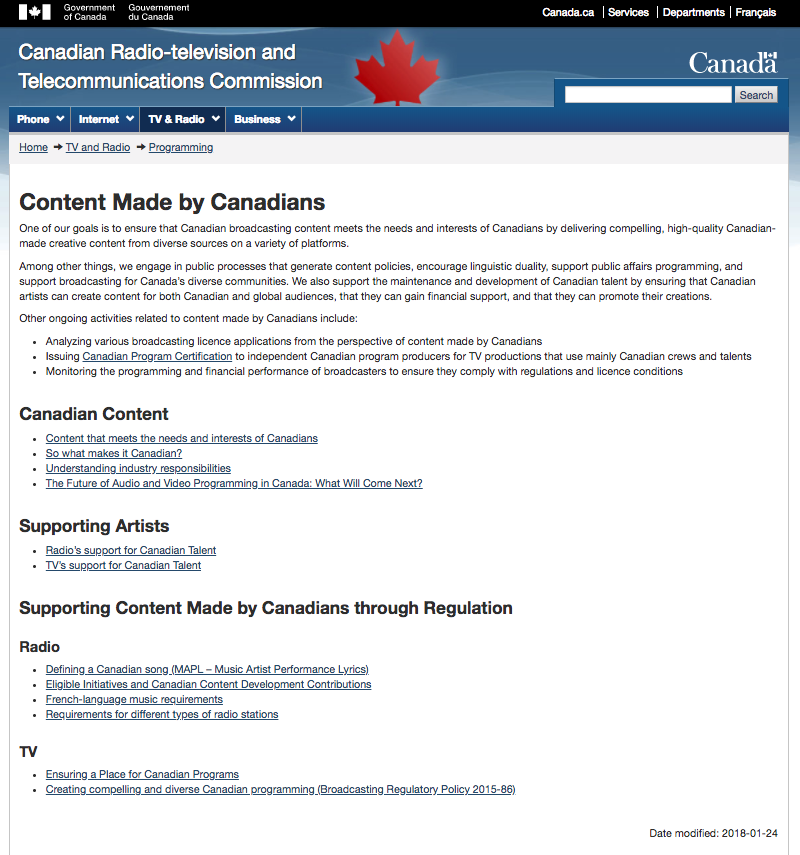
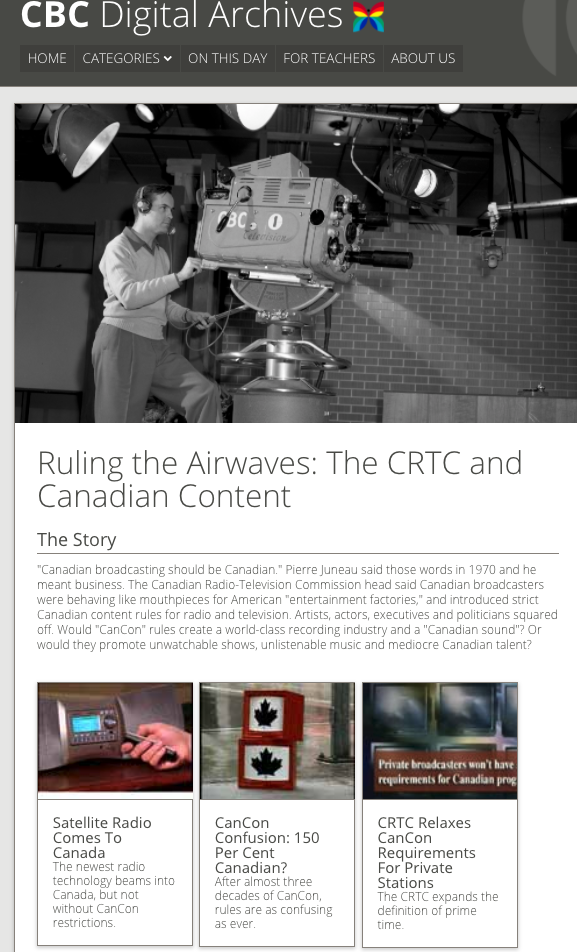
A pretty amazing archive of stories about Canadian Content can be found here…
More in class tomorrow…

Jon

Read More | No Comments

Social Media to Combat Gun Violence?

Hi everyone,

With the latest Florida mass shooting I, like most of you, have witnessed the outcry and response to this act of gun violence on social media.

My post today is based on the following article: https://www.theguardian.com/us-news/2018/feb/21/florida-students-have-turned-social-media-into-a-weapon-for-good

The article states that the Florida students have turned social media into a weapon for good. They are using social media to spread the word on the need to end gun violence and to have stricter gun laws. Social media was even hailed as providing the trapped students the tool to warn others in the school about the shooter during the tragic event and to call for help from the outside world when emergency phone operators were unable to take their calls.

However, on the other hand there are those that argue that in reality social media is not an effective tool to combat gun violence because it leads people to share what has happened without actually doing anything about it. It is even argued that social media makes people believe they are making an effort because they are discussing what is happening and making posts for change but again are not actually making any change.

In addition, in this same article there is a question of whether social media can do more harm then good for there are rumors being spread that the Florida student activists are just paid actors. Also, soon after the shooting pro- Russian gun bots flooded twitter , the bots are able to respond quickly to breaking news because they’re ultimately controlled by humans and or the bots jump on existing hashtags to take control of the conversation and amplify a message. These pro gun groups are spreading misinformation about the shooter such as making him seem related to Islamic extremist groups or a local white nationalist group. Research displayed that twitter also had an increase in similar postings after other mass shootings in the US such as the Las Vegas shooting last year.

This issue of social media or even just the Internet’s ability to manipulate the truth has been a repeated topic this semester. However, the article leaves us with this thought:

“Whether the Stoneman students will be able to maintain their authentic voices amid social media’s crisis of authenticity remains an open question. But for now, they have taken full advantage of the democratic nature of social media to push our democracy forward.” 

For more information about the pro-gun bots : https://www.wired.com/story/pro-gun-russian-bots-flood-twitter-after-parkland-shooting/

Read More | No Comments

Net Activism

Net Activism

For our upcoming presentation, Laura and I are going to address the topic of net activism in its various forms. We will define the term, explore some of the main techniques of net activism, the reactions to these techniques, and possible legal responses to the emergence of various net activism movements.

Please watch the following video debate about the value of net activism to help contextual our presentation:


Thank you,

Read More | No Comments

Class 7 Slides

Here they are, all in one place…

Jon

Read More | No Comments

Question of the Week (Class 7) & Class 7 Poll: John Perry Barlow and “to regulate or not to regulate” social media?

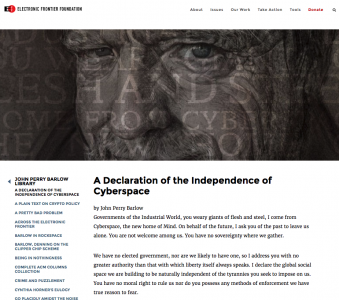
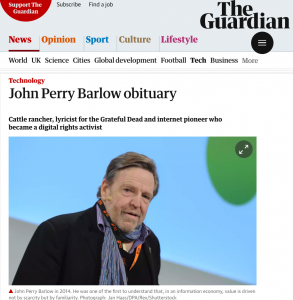
Let me start this in a perhaps unusual place. John Perry Barlow passed away on February 7 2017 at the age of 70. He was many things and could easily be nominated for any list of the most interesting, charismatic, and thoughtful people in recent memory. He possessed instant street cred for having been a lyricist for the Grateful Dead, but there was much more. He was a visionary, spokesman, and poet for the early internet. Most of all he was a protector of of the web’s potential. He was a founder of the Electronic Frontier  Foundation, and famously the author of “A Declaration of the Independence of Cyberspace”…

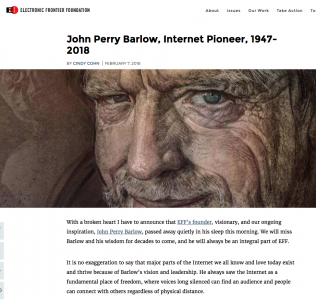
This week’s Question of The Week comes directly from Charlotte’s presentation last week, but Barlow’s life-work provides an interesting backdrop to answering it in the context of interests worth protecting. Perhaps this excerpt from Cindy Cohn’s announcement on the EFF’s website of Barlow’s passing captures it best:

“Barlow was sometimes held up as a straw man for a kind of naive techno-utopianism that believed that the Internet could solve all of humanity’s problems without causing any more. As someone who spent the past 27 years working with him at EFF, I can say that nothing could be further from the truth. Barlow knew that new technology could create and empower evil as much as it could create and empower good. He made a conscious decision to focus on the latter: “I knew it’s also true that a good way to invent the future is to predict it. So I predicted Utopia, hoping to give Liberty a running start before the laws of Moore and Metcalfe delivered up what Ed Snowden now correctly calls ‘turn-key totalitarianism.’”

So without further ado, here is the Question of the Week…

Sorry, there are no polls available at the moment.

If you need to remind yourself of the various possibilities and their contexts, scroll down to the Week 6 slides and take a bit of time to reacquaint yourself with Charlotte’s

Jon

P.S. If you are interested in more on Barlow an excellent Obituary from The Guardian and Cindy Cohn’s announcement can both be found below…

Read More | No Comments

Could AI Be the Future of Fake News and Product Reviews?

The following article aligns with our discussion of using AI technology to create deep fakes. However, this article identifies an experiment conducted by  a group of University of Chicago researchers. The experiment involves using computer algorithms to create fake Yelp restaurant evaluations. The researchers used a machine-learning technique known as deep learning to analyze letter and word patterns used in millions of existing Yelp reviews. Usually when there are mass postings of fake reviews, for example when Hilary Clinton’s book was launched, websites are able to identify it. However, with the researchers’ use of AI, Yelp’s filtering software had difficulty spotting many of the fakes. Even human test subjects were unable to tell the difference between real and fake reviews.

The researchers wanted to conduct this experiment in order to see whether it was possible for individuals to make fake reviews on a mass level in order to impact people’s use of a product, book, restaurant or anything else. This interest displays how things focused on in the media like “fake news” or “deep fakes” really can impact the research and developments in the communication field.

For now, the approach to create fake critics remains to be “crowdturfing” where mass amounts of people are paid to comment on websites. “In crowdturfing online reviews, an attacker creates a project on the Mechanical Turk site and offers to pay large numbers of people to set up accounts on Amazon, Yelp, TripAdvisor or other sites and to then post reviews intended to either raise or sink a product or service’s money-making prospects”.

From here the researchers plan on looking at ways to detect fake news – currently its difficult to create fake news with AI because computers cannot generate the “human touch” in articles however if AI can create fake reviews – anything is possible.

ARTICLE: https://www.scientificamerican.com/article/could-ai-be-the-future-of-fake-news-and-product-reviews/


Read More | No Comments

News of the Week; February 7, 2018

MEDIA, COMMUNICATIONS & NET NEUTRALITY

  1. Hail Mary Pass to Supreme Court Missed Its Mark: Application to Stay CRTC Order Prohibiting Simultaneous Substitution during the Super Bowl Dismissed
  2. Broadcasting Procedural Letter Addressed to Netflix (CRTC)
  3. No Panic: Canadian TV and Film Production Posts Biggest Year Ever Raising Doubts About the Need for Site Blocking and Netflix Regulation (Michael Geist)
  4. Anti-piracy group under fire for website-blocking proposal
  5. Does Canada Even Have a Huge Piracy Problem?: A coalition of powerful organizations wants to block piracy websites in Canada.
  6. Thousands Slam Bell Coalition’s Website Blocking Proposal in Submissions to the CRTC (Michael Geist)
  7. Canada’s SOPA Moment: Why the CRTC Should Reject the Bell Coalition’s Dangerous Internet Blocking Plan (Michael Geist)
  8. Russia Blocks 500 ‘Pirate’ Sites in Four Months, Without a Single Court Order
  9. Bell offers free phone unlocking for all following protests: Telecom had declined requests from non-customers but has changed its policy 
  10. How Bell Let’s Talk became a triple win for BCE, consumers and the mental health cause: In an era of donor fatigue and one-hit wonder online campaigns, BCE’s annual corporate social responsibility effort continues to succeed despite criticism from skeptic
  11. Here’s Ajit Pai’s “proof” that killing net neutrality created more broadband: Pai’s FCC takes credit for broadband deployments that began under Obama.
  12. There are Ajit Pai “Verizon puppet” jokes that the FCC doesn’t want you to read: FCC won’t release emails about joke “collusion” video, says they would harm agency.
  13. Trump’s FCC Pats Itself On The Back For A Historically Stupid Year
  14. FCC Report Falsely Claims Killing Net Neutrality Already Helping Broadband Competition 
  15. ISPs must follow net neutrality in New Jersey, governor declares: ISPs can’t block or throttle traffic if they sell broadband to state agencies.
  16. California’s Net Neutrality Law Takes Another Step Forward
  17. New Jersey The Latest State To Protect Net Neutrality By Executive Order
  18. San Francisco seeks universal fiber broadband with net neutrality and privacy: Affordable broadband and consumer protections for all—that’s the plan at least.
  19. FCC Reaches Consent Decree with Noncommercial Broadcaster Imposing Largest Fine Ever Issued for Underwriting Violations – $115,000
  20. FTC issues comments on FCC’s robocall blocking rules 
  21. Trump Administration Proposes Construction of Federal 5G Wireless Network
  22. A New Frequency Range Could Open Up More Wireless Tech
  23. Comcast accused of demanding $3.5 million “punitive ransom” from rival: Wave Broadband says it had to pay big bucks to avoid losing sports networks.

DIGITAL

  1. As Outlets Like Russia Today Influence Viewers, YouTube Will Add Notices To State-Sponsored Content
  2. YouTube will put disclaimers on state-funded broadcasts to fight propaganda: In efforts to educate viewers on where their news comes from.
  3. Appeals court: Twitter can’t be sued for “material support” of terrorism – 9th Circuit – “We conclude that Twitter has the better of the argument.” 
  4. Court Dismisses — For A Second Time — Lawsuit Seeking To Hold Facebook Responsible For Acts Of Terrorism 
  5. How Twitter Bots and Trump Fans Made #ReleaseTheMemo Go Viral: Russian bots and their American allies gamed social media to put a flawed intelligence document atop the political agenda. That should alarm us.
  6. ‘Fiction is outperforming reality’: how YouTube’s algorithm distorts truth – An ex-YouTube insider reveals how its recommendation algorithm promotes divisive clips and conspiracy videos. Did they harm Hillary Clinton’s bid for the presidency? 
  7. Ich Bin Ein Tweeter: I had enough of the trolling and toxic taunts on Twitter. So I reset my location and “moved” to Germany, the safest social media state in the world. 
  8. Learning The Politics Of “Digital Dissensus” 
  9. Policing the internet – “fake news” and social media offence update 
  10. China launches salvo against “network navy” of trolls who spread fake news: More than 200 arrests, thousands of accounts and websites seized for “illegal speculation.”
  11. Small Creator Sues YouTube Over Faulty DMCA Takedown Procedure
  12. Socioeconomic group classification based on user features / Facebook, Inc.
  13. Facebook Patents Tech To Bucket Users Into Different Social Classes
  14. Telegram iOS app removed from App Store last week due to child pornography: The app was restored only after Telegram removed the content.
  15. Theresa May Again Demands Tech Companies Do More To Right The World’s Social Media Wrongs
  16. It’s Time For A Serious Talk About The Science Of Tech “Addiction”
  17. Push Resumes For An EU Google Tax, With The Bulgarian Government Leading The Way
  18. Nest is done as a standalone Alphabet company, merges with Google: Google plans to “combine hardware, software, and services” between the two companies 
  19. Live Stream Of SpaceX’s Falcon Heavy Rocket Test Peaks At 2.3 Million Concurrent Views
  20. Americans staying home, streaming video, and using less energy because of it – Decouple economic growth from energy consumption: Tell your boss you want to work from home.
  21. Kian Lawley Out At Fox Film ‘The Hate U Give’ After Clip With Racist Remarks Surfaces
  22. On The Internet, Everyone Is A Creator
  23. Logan Paul Discusses “The Hardest Time Of My Life” In ‘Good Morning America’ Interview
  24. Logan Paul Returns to YouTube With ‘Comeback’ Video: ‘I Will Never Forget Who I Am at My Core’
  25. Logan Paul Is Back To Old Antics In First Comeback Vlog After Suicide Scandal
  26. Data-Saving YouTube Go App Arrives In 130 More Countries (But Not The US) 
  27. YouTube “tightening and enforcing” policies toward content creators: “We realise we have a serious social responsibility to get these emerging policy issues right,” says CEO 
  28. YouTube Announces 3 Potential Punishments For Top Creators Who Harm The Broader Community
  29. YouTube CEO Shares 5 Goals With Creators For 2018: “Addressing Your Concerns About Demonetization Is A Top Priority”
  30. Kylie Jenner Chooses YouTube For Baby Reveal, Nabs 28 Million Views In 24 Hours
  31. YouTube On ‘Play Button’ Awards: “Not All Creators Who Apply Will Receive Awards”
  32. YouTube TV subscribers can now watch live TV on Apple TV, Roku devices: Announcement comes after the rollout was delayed at the end of 2017.
  33. As The Winter Olympics Approach, YouTube Shares Data And Prepares To Host Highlights 
  34. YouTube Uses Its Version Of Snapchat’s Stories For Black History Month Campaign
  35. Snapchat Uses Live Streaming To Highlight Top Moments From 2018 Winter Olympics
  36. Patreon Introduces Exclusive Snapchat-Like Content For Donors, By Creators
  37. How Snapchat Is Sending #Metoo Down The Memory Hole: Disappearing-messaging apps may keep snoopers away—but they can also prevent us from preserving the past and finding justice in the future.
  38. BuzzFeed And NBCUniversal’s Latest Project Targets Millennial Parents
  39. Putting Pinners First: How Pinterest Is Building Partnerships For Compassionate Content Moderation
  40. Implementing Transparency About Content Moderation
  41. Tosca Musk Launches Streaming Service That Celebrates The Female Gaze 
  42. Hulu’s Super Bowl stream fails during final moments of game: Some customers lost video right before the end
  43. Hulu and Vue fumbled during the Super Bowl (but so did NBC): Two of the big streaming TV services cut out at critical moments in the game.
  44. Warner Music Hits $1 Billion in First Quarter, Digital Revenue Up 20%
  45. Study Suggests Shutting Down Filesharing Sites Would Hurt Music Industry, New Artists
  46. Appeals Court Makes A Mess Of Copyright Law Concerning ISPs And Safe Harbors
  47. BMG V. Cox is Major Copyright Victory for Music Industry
  48. Cox Not Entitled to DMCA Protection Given Lax Infringer Policy
  49. Fourth Circuit Raises Bar for DMCA Safe Harbor Defense 
  50. The Gig Economy’s Tipping Point
  51. Alexa, print money: Even Bezos stunned by Q4 Amazon income – Exceeds operating income estimate by 69%; hints at exactly how well Echo is doing.
  52. Inside Amazon’s Artificial Intelligence Flywheel: How deep learning came to power Alexa, Amazon Web Services, and nearly every other division of the company.
  53. What Amazon Does to Poor Cities: The debate over Amazon’s HQ2 obscures the company’s rapid expansion of warehouses in low-income areas.
  54. Don’t Make AI Artificially Stupid In The Name Of Transparency
  55. AI Just Learned How To Boost The Brain’s Memory
  56. Half of Americans Want Universal Income, but Expect AI Companies to Pay It 
  57. Greedy, Brittle, Opaque, And Shallow: The Downsides To Deep Learning – We’ve been promised a revolution in how and why nearly everything happens. But the limits of modern artificial intelligence are closer than we think.
  58. Photo Algorithms ID White Men Fine—Black Women, Not So Much
  59. Line-Drawing Exercises: Autonomy and Automation – An existential worry lies beneath concerns about the future of AI. We as humans fear that we will lose our autonomy as we pursue automation with such abandon. (John Palfrey)
  60. The Expansion Of Algorithmic Governance: From Code is Law to Law is Code (Samer Hassan & Primavera De Filippi)
  61. Irony Alert? Tech Insiders Form Organization to Combat the Dangers of Technology
  62. The End Of Data Without Borders: The storage and transmission of data around the world involves a constant clash of competing local, regional, and national regulations. But why does anyone care where data is physically located?
  63. Our Hackable Political Future
  64. The Big ICO Swindle: Many cryptocurrency speculators are banking on the theory that someone dumber than them will buy their tokens for more than they paid. That’s a pretty good bet … until it isn’t.
  65. A Classic Scam Finds New Life Stealing Bitcoin On Twitter
  66. Decrypting Taxation of Cryptocurrency
  67. Why experts are worried about Tether, a dollar-pegged cryptocurrency: Markets treat a tether as though it’s worth $1. But what if it’s not?
  68. Cryptocurrency botnets are rendering some companies unable to operate: Smominru botnet has infected 526,000 machines, generated as much as $3.6 million.
  69. Crypto Utopia In Puerto Rico: Digital Evangelism Or Disaster Capitalism? (Andres Guadamuz)
  70. A Video Platform That Wants To Be YouTube For Cryptocurrency Users Has Raised $20 Million
  71. Cryptocurrency in Small Bytes: Who’s in Charge Here Anyway? The U.S. Regulatory Landscape for Token Offerings
  72. The Wired Guide To The Blockchain: It’s super secure and slightly hard to understand, but the idea of creating tamper-proof databases has captured the attention of everyone from anarchist techies to staid bankers. 
  73. Feds Take Down A Half-Billion Dollar Cybercrime Forum After 7 Years Online
  74. No “Bright Line” In Influencer Marketing No-Nos, Tubefilter And SAG-AFTRA FTC Panel Shows
  75. ‘Catalog Of Missing Devices’ Compiles The Useful Tech Products DRM Is Preventing Us From Owning
  76. Viacom Will Reportedly Acquire Online Video Gathering VidCon
  77. It’s Official: Viacom Announces Its Acquisition Of VidCon
  78. Mitú, NFL Announce Partnership To Engage Latino Football Fans
  79. This Pastor Is Putting His Faith In A Virtual Reality Church: D.J. Soto believes Christianity can be renewed through worship in virtual space. His VR mega-church is even attracting atheists.
  80. Uber doesn’t want jury to see report, but judge says Uber is “stuck” with it: Former Uber CEO Travis Kalanick may take the stand today.
  81. Waymo presents damning internal messages from Uber, which responds in kind
  82. Kalanick agrees: Google was and is “in the lead” in autonomous vehicles – According to a colleague’s notes, Uber’s co-founder sought “pound of flesh.”
  83. Uber: We had “no justification” for covering up data breach – Republican senator – data breach incident “raises red flags within this committee.”
  84. Waymo v. Uberkicks Off With Travis Kalanick In The Crosshairs
  85. Waymo v. Uber’s big Question: What On Earth Is A Trade Secret, Anyway?
  86. Google joins “universal stylus” group, hopes for cross-device compatibility: Can you build a universal stylus standard without Apple, Microsoft, and Samsung?
  87. Push Resumes For An EU Google Tax, With The Bulgarian Government Leading The Way
  88. Samsung leader walks from prison after bribery charges “suspended”: “Samsung is above the law and the court” says national assembly member.
  89. iPhone X Damage Report: Two Months Later
  90. How will new iPhones manage power? Apple’s response to senator raises questions: Apple is also exploring options for those who paid full price for new batteries.
  91. Op-ed: Apple was right to throttle iPhones, but some things still need to change – Prioritizing battery life and stability over speed was the best move for users.
  92. Apple sets quarterly revenue record following iPhone X launch
  93. Apple, Verizon Continue to Lobby Against The Right To Repair Your Own Devices
  94. It’s Time For A Serious Talk About The Science Of Tech “Addiction”
  95. The Formula For Phone Addiction Might Double As A Cure
  96. The Secret To Breaking Up With Your Phone? Remember That You Will Die.
  97. Comprehensive US cell phone safety study inches toward publication: In this study, being in one of the control groups was fatal.
  98. Relatively few LG customers will see any money from “bootloop” lawsuit: Chamberlain v. LG was sent to arbitration in June 2017; now LG has quietly settled.
  99. Toronto lawyer serves claim with Instagram
  100. IP monitor – Government is reviewing Copyright Act for currency with digital technology
  101. Moderation Is The Commodity
  102. 5 Takeaways From Tech Leaders’ Content Moderation Conference: Tech companies’ legal leaders and policy experts gathered at Santa Clara University School of Law on Feb. 2 for a day of panels on content moderation and removal.
  103. Behold, the 157 new emoji for 2018: New smileys, animals, hair colors, and lots more arrive in Unicode Emoji 11.0.
  104. Rebalancing Regulation of Speech: Hyper-Local Content on Global Web-Based Platforms (Chinmayi Arun)
  105. Co-founder of EFF, John Perry Barlow, dead at 70: “The Internet we all know and love today exists and thrives because of Barlow’s vision.”
  106. Mourning John Perry Barlow, The Bard Of The Internet

CREATIVITY

  1.  Ed Sheeran Among the Latest Musicians Accused of Copying Australian Artists
  2. Insights: After Music’s Massive Week, Can People Finally Make Money From It Again?
  3. Tarnishing The History Of Martin Luther King Jr.: Copyright Enforcement Edition
  4. Director Of Thor: Ragnarok Pirated Clips For His Sizzle Reel
  5. International Inconsistencies In Copyright: Why It’s Hard To Know What’s Really Available To The Public
  6. Israeli Music Fans Sue Two New Zealanders For Convincing Lorde To Cancel Her Israeli Concert 
  7. Public School Board Member Threatens Boss Of Woman Who Spoke Out Against School Book Banning
  8. Come Witness The Commentators That Help The NFL Fool The Public About Its ‘Super Bowl’ Trademark Rights
  9. BrewDog Beats Back Trademark Action From The Elvis Presley Estate
  10. Moosehead Breweries Cuts And Runs From Trademark Suit Against Hop ‘N Moose Brewing
  11. Best Buy Will No Longer Sell CDs and Target May Be Next
  12. Online Talent Search Company Settles FTC Allegations it Collected Children’s Information without Consent and Misled Consumers
  13. Understanding the Consumer Review Fairness Act of 2016 (Eric Goldman)

SURVEILLANCE & PRIVACY

  1. Right to be Forgotten, eh? Canada’s Privacy Commissioner Says Law Requires Search Engine De-indexing
  2. Canadian Privacy Commissioner Report Says Existing Law Already Gives Canadians A Right To Be Forgotten
  3. It is time to overhaul Canada’s data protection—your rights are at stake – Opinion: A draft position by Canada’s privacy commissioner on the right to be forgotten shows how our inadequate laws are being overstretched
  4. Here’s what you need to know about Canada’s ‘extraordinarily permissive’ new spying laws
  5. China Exporting Its Surveillance Tech And Philosophy To Other Countries, Helped By Equipment Donations
  6. Devin Nunes Releases Memo That Doesn’t Show The Surveillance Abuses He Hypocritically ‘Cares’ About
  7. Missouri Governor Sued Over His Office’s Use Of Self-Destructing Communications
  8. Judge should order governor to stop using ephemeral messaging app, lawyers say – Missouri governor’s lawyer: Use of Confide is protected under the First Amendment.
  9. Single-Pixel Tracker Leads Paranoid Turkish Authorities To Wrongly Accuse Over 10,000 People Of Treason
  10. Digital insecurity of journalists in Pakistan: DRF report
  11. IBM’s New AI Can Predict Psychosis in Your Speech
  12. The Equifax “Lock & Alert” app works, but what does it do?: Equifax’s new free phone app can “lock” your Equifax credit report. Just beware of typos.
  13. Hacker Lauri Love Wins Extradition Appeal; Won’t Be Shipped Off To The US
  14. In just 24 hours, 5,000 Android devices are conscripted into mining botnet: Worm-like infection targets devices that have seldom-used port 5555 open.
  15. Why cops won’t need a warrant to pull the data off your autonomous car: “It’s like instant replay in the NFL; I can tell what happened.”
  16. Facial Recognition in Retail: “Attention all Shoppers: We Already Know Everything about You”
  17. The House That Spied on Me
  18. Mind The Gap: This Researcher Steals Data With Noise, Light, And Magnets
  19. GDPR: The Most Frequently Asked Questions: Is a Service Provider’s Privacy Shield Certification Good Enough?
  20. Children and the GDPR
  21. Data is power: Towards additional guidance on profiling and automated decision-making in the GDPR (Frederike Kaltheuner, Elettra Bietti)

GAMES

  1. Valve suspends Counter-Strike co-creator after arrest for sexual exploitation of a child
  2. Valve Suspends Counter-Strike Co-Creator Following Disturbing Allegations: Cliffe has been suspended “until we know more,” says Valve.
  3. Counter-Strike’s Jess Cliffe arrested for sexual exploitation of a child: Co-creator of classic first-person shooter suspended by Valve until more is known of charges
  4. Counter-Strike Co-Creator Charged With Paying 16-Year-Old For Sex
  5. Charges filed, details emerge for arrest of Counter-Strike’s co-creator: Charged with commercial sexual abuse of a minor.
  6. “A risk to the community”—Counter-Strike co-creator faces $150K bail post-arrest: Defense acknowledges sexual contact, says client “had no idea” witness was a minor.
  7. Subnautica developer fired over “many hateful statements”: Sound designer Simon Chylinski dropped from underwater survival game after history of insensitive tweets
  8. Is it right to classify excessive video game play as a health disorder?: “Once we say games are also an activity that pulls for that compulsiveness, the question is why aren’t more people then getting pulled into it?”
  9. ‘Dangerous gaming’: is the WHO right to class excessive video game play as a health disorder?: Industry figures question research that ‘pathologises’ compulsive gaming, while scientist involved defends move to address addiction
  10. Germany is considering a ban on loot boxes
  11. German Youth Protection Commission investigates loot boxes: It’s “conceivable” that loot boxes violate existing regulation, says commission chairman
  12. Quantic Dream labels claims of toxic conditions as “smear campaign”: Council of Paris investigating public funds awarded to studio, and considering tighter regulations for companies that do not care for staff
  13. EA stock reaches all-time high ahead of Battlefront II loot box return: Company’s stock rose 7%, peaking at $131 following recent financial results
  14. Take-Two swings to profit, has high hopes for Red Dead Redemption 2
  15. The Myth of Metacritocracy: 10 Years Ago This Month: EA learns a costly lesson about striving for excellence and Take-Two tells it to take a hike
  16. Take-Two’s usual performers carry company to solid quarter: Record quarters for Grand Theft Auto Online and NBA 2K continue to tide publisher over during a light year of major releases
  17. Over 1M Battlegrounds cheaters were banned in January alone
  18. PUBG Corp prepares to introduce new anti-cheat solution as total bans exceeds 2.5m: PlayerUnknown’s Battlegrounds bans one million cheaters in January alone
  19. Donkey Kong scoreboard strips Billy Mitchell’s high score claims 
  20. Indiegogo threatens to recoup Spectrum Vega+ funds, new release date promised: Former managing director of Retro Computers Ltd refutes allegations made by company’s current directors
  21. Kickstarter and games in 2017
  22. Atari Gets The Settlement It Was Surely Fishing For Over An Homage To ‘Breakout’ In KitKat Commercial
  23. Amid furor over past sexism, Atari co-founder loses prestigious award: Bushnell apologizes for behavior, “applauds” GDC for promoting awareness.
  24. Twitch Ended 2017 With 15 Million Daily Visitors, 27K Partnered Streamers
  25. Konami apologizes for announcing nuclear disarmament (in Metal Gear Solid V): Server-wide cutscene event seems to have been activated prematurely by a glitch.
  26. Capcom’s hunt for a global audience: Monster Hunter was perhaps the best example of a “big in Japan” game – until Capcom’s persistence and confidence finally paid off this week
  27. Capcom lays off workers at Dead Rising studio
  28. Layoffs at Capcom Vancouver: 30% of studio laid off as Dead Rising developer reportedly sees one project cancelled, another has scope reduced
  29. Report: Gameloft closes New Orleans studio, layoffs at Gameloft Madrid
  30. Sales and profits slip at Sega despite bump in physical sales
  31. Jump in physical game sales can’t save Sega from sales and income drops: Games success not enough to overcome slumping arcade and smartphone performance
  32. Sonic 3D Blast dev releases director’s cut after 25 years
  33. Mojang is shutting down Scrolls’ online servers
  34. Existing titles drive profits at Square Enix as sales fall flat
  35. Smartphone success boosts Square Enix after a quiet nine months on consoles: Online titles Final Fantasy XIV and Dragon Quest X boost sales and subscriber numbers
  36. The 8 Ways Nintendo Can Double Down On Switch’s Success
  37. I’m A Nintendo Switch N00b Who Just Got A Hands-On With Labo
  38. The Switch’s premium online service is launching this September
  39. Nintendo to continue mobile push with Mario Kart Tour
  40. Nintendo will release a Mario Kart mobile game by March 2019: Mario Kart Tour will launch in the next financial year, the publisher said today
  41. Nintendo announces Super Mario movie in partnership with Illumination: Animation studio behind Despicable Me and Minions franchises to co-produce with Shigeru Miyamoto
  42. Why isn’t Nintendo Switch breaking records in the UK?: It’s the fastest-selling games console in almost every market it’s been released in, but not Britain
  43. Nintendo working on Mario movie with Minions creator Illumination
  44. Super Mario Odyssey producer settles the debate over Toad’s head: Is it a hat, or part of his anatomy?
  45. Why Nintendo Switch needs to find a new model of discovery: The family-friendly platform must learn from Steam’s cautionary tale
  46. After a rocky launch, Failbetter Games ends indie fund and lays off some staff
  47. NCsoft posts another year of record-breaking growth: Slight declines in mobile aren’t enough to ruin the show as online PC games enjoy a strong quarter
  48. Steam Winter Sale Data and the Effects of a Front Page Feature
  49. Report: Google considering streaming service for games
  50. Google prepping game streaming service – Report
  51. Google’s “Yeti” is reportedly a gaming hardware, streaming service beast: According to The Information, Google has been working on this for the past two years.
  52. How mobile game devs are evolving test and launch strategies: Google Play biz dev manager Emily Putze tracks how the traditional launch playbook for mobile games is changing
  53. Sony’s software strength offsets flat hardware sales: Sony shipped 9 million units of the PlayStation 4 in Q3, down 700k over last year
  54. Has the PS4 peaked? Annual console shipments are flat for 2017: This is about the age when Sony systems start their long, slow decline.
  55. Kaz Hirai steps down as president and CEO of Sony Corp.: Hirai hands leadership to CFO Kenichiro Yoshida after six years at the helm
  56. Sony financials: PlayStation software shines as hardware slows
  57. As Sony CEO Kaz Hirai steps down, the future of some products is in question: His successor has built a reputation for making tough cuts to get in the black.
  58. Sony Interactive Entertainment files Inter Partes Review of 3D Video Patent
  59. Upcoming PlayStation 4 update includes playtime management 
  60. Microsoft responds to indie retail backlash over Xbox Game Pass: Platform holder “pleasantly surprised” by store demand, considering broadening its distribution plans
  61. Always Be Pitching: How to find and talk to publishers to survive as an indie
  62. Layoffs at Nexon America after company restructuring
  63. Jobs lost as Nexon America restructures: But publisher insists there’s no significant impact to overall workforce, layoffs unrelated to struggling Lawbreakers
  64. UK game dev sector grows more than four times the rate of the economy in 2017: Games development sector contributes nearly £1.5 billion to the UK’s GDP, says TIGA report
  65. Pillars of Eternity II director on Obsidian’s shift from studio-for-hire to building its own IP: Working on your own IP is “less about the freedom and more about the institutional knowledge to understand what the IP is”
  66. New studio Lunar Great Wall will also teach games development: Italian start-up’s Claudio Giacopazzi tells us how the team will balance creation and education
  67. Encouraging charity with Don-Ay, the first ‘donation game’: Italian developer Affinity Project talks us through its mobile endless runner that enables players to help save real-world animals
  68. Gamevil and Com2us merge in the US: Mobile companies combine to focus efforts in North America
  69. Keywords expects $186m in revenues after 11 acquisitions in 2017: Service empire’s studio count has grown eightfold in the last five years
  70. Examining the role outsourcing plays in modern game development
  71. Tamatem nets $2.5M to localize mobile games for Arabic-speaking markets
  72. Q&A: Translating the humor & tone of Yakuza games for the West
  73. Trailmix aims to reinvent casual games – with a little help from Supercell: Backed by $4.2m from Supercell, King veterans Carolin Krenzer and Tristan Clark will push toward a richer and more meaningful take on casual gaming
  74. Human: Fall Flat dev credits community feedback for success
  75. “It’s hard to put in words how life-changing blockchain technology will be”: EverdreamSoft plans to demonstrate the new tech’s power by enabling players to sell – and more importantly own – in-game cards
  76. Blog: Can week-one Steam sales predict first-year sales?
  77. Latest Steam survey puts Oculus Rift and HTC Vive with equal market share
  78. Pokemon Go developer Niantic scoops up AR API maker Escher Reality
  79. Open-source game dev tool Godot Engine adds VR support
  80. Blog: The next surprise billion dollar game will be on Alexa
  81. Game dev in Oceania: A hands-off Aussie gov’t, and a Kiwi PM’s visit
  82. Blog: Are casual games maturing? 
  83. How Tetris was discovered in America
  84. Smithsonian American Art Museum puts out call for indie devs
  85. Applications open for Smithsonian American Art Museum exhibition: Smithsonian puts out call for indie devs to explore this year’s theme of “game spaces”
  86. Machinima founder and VR developer Hugh Hancock has passed away

Jon

Read More | No Comments

  • Previous
  • 1
  • …
  • 47
  • 48
  • 49
  • …
  • 62
  • Next

Communications Law


RSS

Login with your CWL


Creative Commons License

Peter A. Allard School of Law
Vancouver Campus
Allard Hall
1822 East Mall
Vancouver, BC Canada V6T 1Z1
Back to top
The University of British Columbia
  • Emergency Procedures |
  • Terms of Use |
  • Copyright |
  • Accessibility