The “cloud” has come to mean the storing and accessing of data (including programs) over the internet rather than on on our device (computer, phone or otherwise). The official definition of the U.S. National Institute of Standards and Technology is: “Cloud computing is a model for enabling convenient, on-demand network access to a shared pool of […] Read More
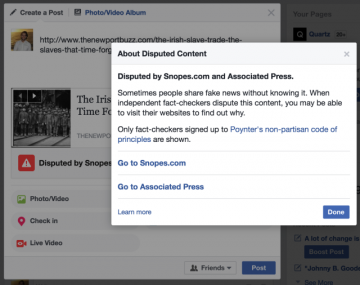
This week, Facebook has begun implementing its new strategy, announced a few months ago, in reducing the amount of “fake news” posted on its platform. In this Quartz article, the writer attempts to publish a fake news article about “Irish Slaves” and is met with a series of warnings that the user has to “click through” in order to post the article.
Here’s a brief rundown: On pasting the link to the article in the “What’s on your mind?” text box, a warning sign pops up with a “Disputed by Snopes and Associated Press” label. Clicking the label produces the tool-tip window shown in the picture below. Attempting to post the article gives you a final ‘are-you-sure?’ (with the same warning) and an option to “post anyway”.
Several questions are raised:
How is Facebook automatically tagging these articles as fake news? Does the algorithm simply refer to a hand-picked list of ‘known’ fake news websites, or is it somehow more complicated?
Are users who are more likely to post or share fake news articles likely to be deterred by such warnings?
Is Facebook sufficiently addressing the issue of “who should decides what’s fake news” by referring to “independent fact-checkers” Snopes.com and Associated Press? (a question that the users in question 2 might be asking)
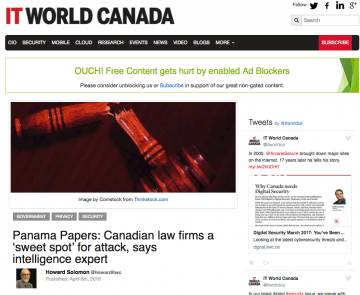
Our presentation this week is on threats to online security that lawyers face and how to combat them. Please read the article below, as well as taking a look at the videos attached. See you Wednesday!
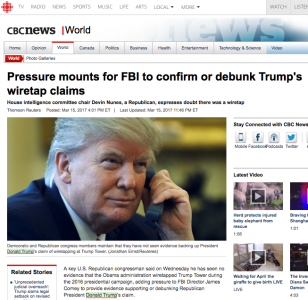
This week Josh and I will be presenting on the topic of journalism. Throughout the presentation, we will be talking about the history of journalism, how it is currently regulated by common law and statute, and about recent issues that have emerged over the past few years (i.e. Fake news, censorship, etc.)
Here are links to a few readings:
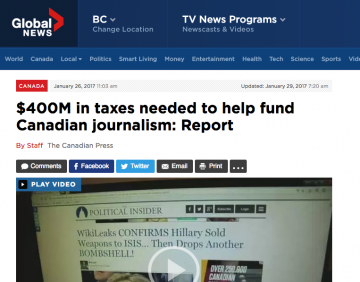
This article talks about the effects of technological advancement and its effect on the journalism industry’s ability to make money (thus affecting the way we regulate journalism)
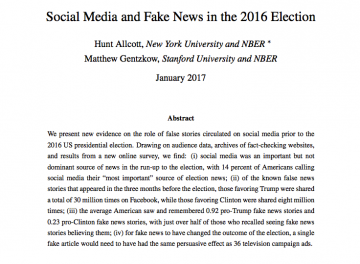
This study reveals some of the effects of fake news on the democratic process. You only need to read the introduction and the conclusion:
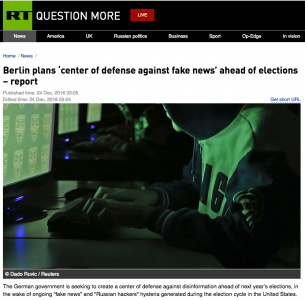
Here’s an article discussing the possibility of an answer to the ‘fake news’ epidemic, but also poses a serious threat from censorship:
Thanks to everyone in-class today for participating in the collaborative exercise of setting some new communications law principles for Canada. Wish it were quite so simple…
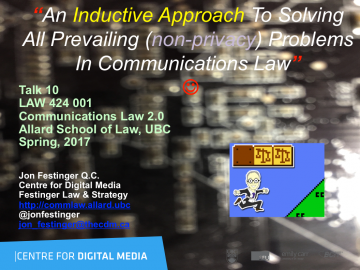
Slides which formed the basis of the festivities can be found below…
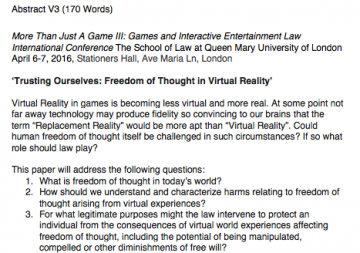
As promised in class today below you will find a draft abstract for a talk that I will be giving in the U.K. on April 6. Also have included a link to the conferences’ website on which you can find the current draft programme. No obligation on anyone’s part, but all questions and comments are helpful. Thanks.





 Communications Law
