The “cloud” has come to mean the storing and accessing of data (including programs) over the internet rather than on on our device (computer, phone or otherwise). The official definition of the U.S. National Institute of Standards and Technology is: “Cloud computing is a model for enabling convenient, on-demand network access to a shared pool of […] Read More
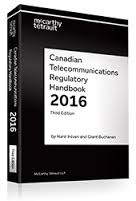
We are going to do a bit of in-class group work tomorrow. To the extent as many people in the class as see this bring their McCarthy Tetrault Red (Canadian Broadcasting Regulatory Handbook) & Black (Canadian Telecommunications Regulatory Handbook) texts, please do. They will be a useful reference tool for the exercise. I will have extra copies available in any event.
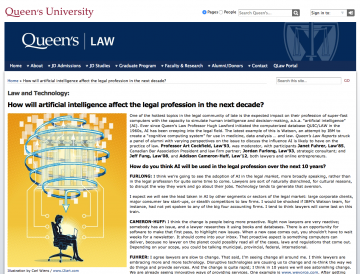
This week we (Brendan and Mojan) are presenting on Artificial Intelligence and its impact on the legal community. Please see the two reports and the TedTalk for preparation. Have a great weekend!
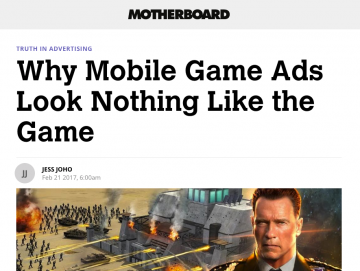
I came across an article which makes an interesting addendum to the topic on which I presented last week: “Why Mobile Game Ads Look Nothing Like the Game” (Motherboard). As the title implies, it focuses on ads for mobile games (on TV and elsewhere), and has more of an American perspective than our presentation did. Here’s a short excerpt:
The blatant disregard for player expectations in Mobile Strike‘s trailer begs the question: how can free-to-play companies legally get away with this . . . ?
The answer is about as dissatisfying as playing Mobile Strike after watching its CGI trailer. The issue stems less from the gaming industry and more from the vague language of the FTC’s Truth in Advertising law—along with the perpetual speedbump of a slow justice system. Potential plaintiffs attempting to file a false advertising lawsuit against these companies would have to prove that the advertising is likely to mislead “reasonable” consumers—which is a slippery terminology in the fast-paced, constantly developing app marketplace.
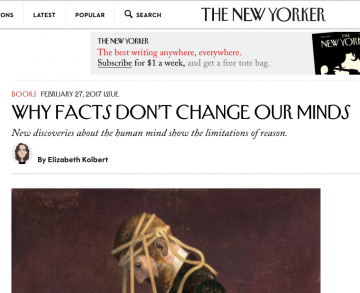
Here’s a very intriguing article from The New Yorker about information processing and human perception. I suspect that many of you will find this piece interesting and (perhaps more importantly) enjoyable to read. The author relates modern phenomena (e.g. fake news) to key developments in our ancient past, with references to a variety of disciplines, in a distinctly accessible format.
Some quotes that I found particularly memorable as well as useful for capturing and conveying the general tone of the piece:
“People believe that they know way more than they actually do. What allows us to persist in this belief is other people.”
“We’ve been relying on one another’s expertise ever since we figured out how to hunt together, which was probably a key development in our evolutionary history. So well do we collaborate, Sloman and Fernbach argue, that we can hardly tell where our own understanding ends and others’ begins.”
“As people invented new tools for new ways of living, they simultaneously created new realms of ignorance; if everyone had insisted on, say, mastering the principles of metalworking before picking up a knife, the Bronze Age wouldn’t have amounted to much. When it comes to new technologies, incomplete understanding is empowering.”




 Communications Law
