Video & slides below…
Jon

The “cloud” has come to mean the storing and accessing of data (including programs) over the internet rather than on on our device (computer, phone or otherwise). The official definition of the U.S. National Institute of Standards and Technology is: “Cloud computing is a model for enabling convenient, on-demand network access to a shared pool of […] Read More
Video & slides below…
Jon
Presenters: Alex Farrant, Dylan Bell, Michael Hopton, Seb Lloyd & Melanie Heathman
Please read this article: https://www.michaelgeist.ca/2022/02/not-ready-for-prime-time/
It is a quick and interesting read about user-generated content and Bill C-11.
Hi everyone,
Adam, Will, and I (Amit) made a video presentation on the topic of internet regulation and the upcoming Online Safety Bill in the UK. In this video we talk about what this bill is about, the landscape that has prompted this bill, how the bill is designed/to be enforced, and comparable laws in the US and Canada.
To acquaint yourself with this topic we suggest you read this article before watching the video: https://www.bbc.com/news/technology-59638569
Here is a link to our video, please give it a watch: https://drive.google.com/file/d/14NNAXloyNGL8I3jRaovbKlgg58onOMAC/view?usp=sharing
You may have to download the video if the Google drive link doesn’t let you play it in preview.
Thank you,
Adam, Amit, & Will
Hi guys,
Skye, Kirsty and I (Molly) are looking forward to presenting in class tomorrow. Democratization is defined as a transformation of political institutions that leads to the establishment and expansion of democratic institutions in a political system, and there is certainly no doubt that social media, albeit a recent phenomenon has a profound effect on democratization. Ever since the Arab Spring started ten years ago, social media has been argued to have facilitated pro-democracy movements however recent events have shown the flip side of that coin. Tomorrow we will discuss whether social media is a boon or a bane for democracy, refer to recent popular uprising to analyze this, and scrutinize whether reform or regulation is needed in Canada.
It would be great if you guys could listen to this podcast “Breaking Bongo” available here: https://www.wnycstudios.org/podcasts/radiolab/articles/breaking-bongo (there is also a transcript version available on this same link). This podcast will provide context into the powerful and potent effect communication channels have on democracy. It is a really interesting podcast based on the role of communications and social media in a turbulent Gabon. Hope you guys enjoy.
Looking forward to tomorrow.
Take care,
Kirsty, Molly & Skye
Hi!
Here’s my presentation on PIPEDA Reform in the Age of AI for next week.
https://docs.google.com/presentation/d/1yIBCDGmB4WHBtsJmZVOEiSWrbWtqTAyEqcO4lU6Bgxw/edit?usp=sharing
For some background, here’s a brief summary of PIPEDA:
If you are interested in the subject of data privacy and AI, feel free to check out the proposed reforms here:
A Regulatory Framework for AI: Recommendations for PIPEDA Reform https://www.priv.gc.ca/en/about-the-opc/what-we-do/consultations/completed-consultations/consultation-ai/reg-fw_202011/
Uma
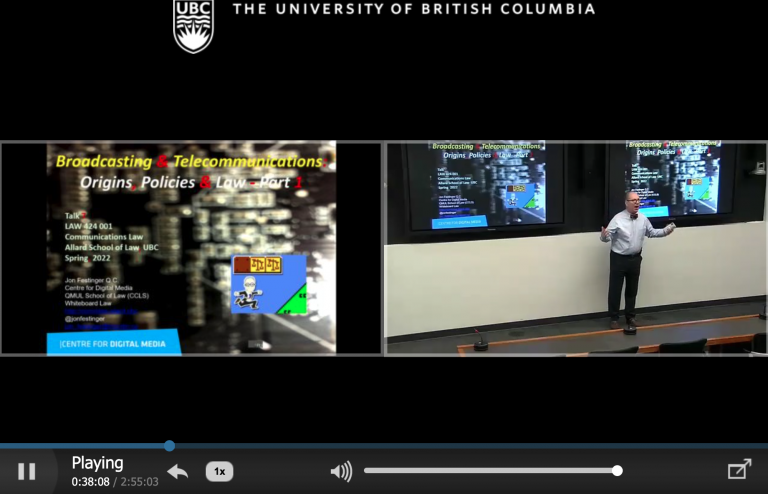
Video & slides below…
Jon
Hi all,
I came across this article from WIRED which discusses the use of governance tokens in web3 as a means of democratizing moderation and providing users more control over platforms. However, the article also highlights that since governance tokens are typically dispersed based on how much money users have invested in a platform, the likely result is a class divide on the new internet between those who can afford control and those who cannot (which is essentially where we’re at currently, with corporate control of social media).
I think articles like this highlight the problematic trend of web3 technologies being focused on turning all aspects of our lives into things that can and should be bought and sold. In the coming years, I think governments will be forced to bridge communications laws, securities laws, and consumer protection legislation to ensure that these new technologies and their potential to exclude don’t exacerbate existing social and technological inequalities.
A petition for a relevant issue in relation to Communications Law. See below.
https://www.taxpayer.com/petitions/defund-the-cbc-and-end-media-bailout
To Prime Minister Justin Trudeau:
The CBC costs taxpayers more than $1 billion per year and the federal government is giving media organizations a $600-million bailout.
Taxpayers shouldn’t be forced to fund the CBC and other media organizations. We should be able to choose which organization we want to support with our own money.
We, the undersigned, call on the federal government to defund the CBC and end its media bailout.
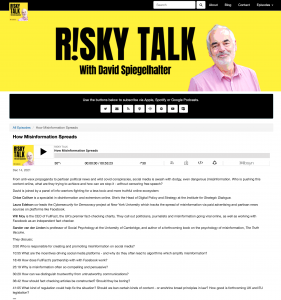
If at all possible please listen in advance…Click on the image to get to the podcast.
Thanks, Jon
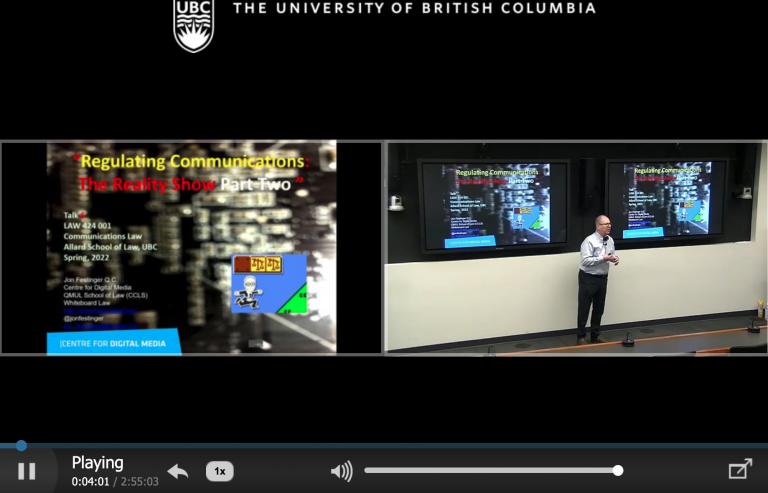
Video & slides below…
Jon
 Communications Law
